

CRM data underpins nearly every go-to-market decision, from territory design and account planning to forecasting and automation. All of it depends on one assumption: that the underlying data is accurate and complete.
In reality, that assumption rarely holds. Most CRMs don’t reflect real organizations accurately. They store records that are often duplicated, fragmented across teams, or disconnected from the actual corporate structures they represent.
When a CRM’s view of an organization is inconsistent, everything built on top becomes unreliable. Territories drift, automation fails, forecasts lose credibility, and sales performance is measured against a distorted view of the market.
Entity identity resolution solves this problem at the source. It ensures every CRM account maps to a verified, real-world organization, and that relationships between entities, including parents, subsidiaries, and groups, are accurate and continuously maintained.
What causes CRM data inaccuracy?
CRMs store data from many different sources, and small inconsistencies quickly add up.
The same company often shows up as multiple records, created by different teams, imported from various databases, or updated at different times. Mergers, acquisitions, rebrands, and local naming variations all make the problem worse.
Common issues include:
- Leads and accounts stored separately, creating duplicate company records
- Manual record creation combined with automated imports and integrations
- Regional teams maintaining their own versions of the same global organizations
- Company names in different formats, abbreviations, or local variations
- Corporate hierarchies changing through mergers, acquisitions, or reorganizations
The result is a fragmented view of the same organization.
Teams spend weeks merging duplicates and fixing conflicting records, only for the same issues to reappear as new data is added. Static data quickly becomes outdated, and one-off enrichment has limited accuracy.
Without a verified representation of each organization, the CRM becomes a patchwork. Manual cleanup addresses symptoms but never solves the root problem.

Entity identity resolution: the missing foundation
Entity identity resolution solves this by creating a single, verified representation of every real-world organization.
Instead of relying on individual CRM records, it establishes a canonical version of each organization. All related records link back through a persistent identifier, creating a trusted reference point.
This also helps to clarify relationships between entities. Parent companies, subsidiaries, and operating units form consistent hierarchies that reflect how organizations actually operate.
At its core, entity identity answers a simple but essential question: which real organization does this account represent?
Once that question is answered consistently, teams can finally trust the rest of the CRM data.
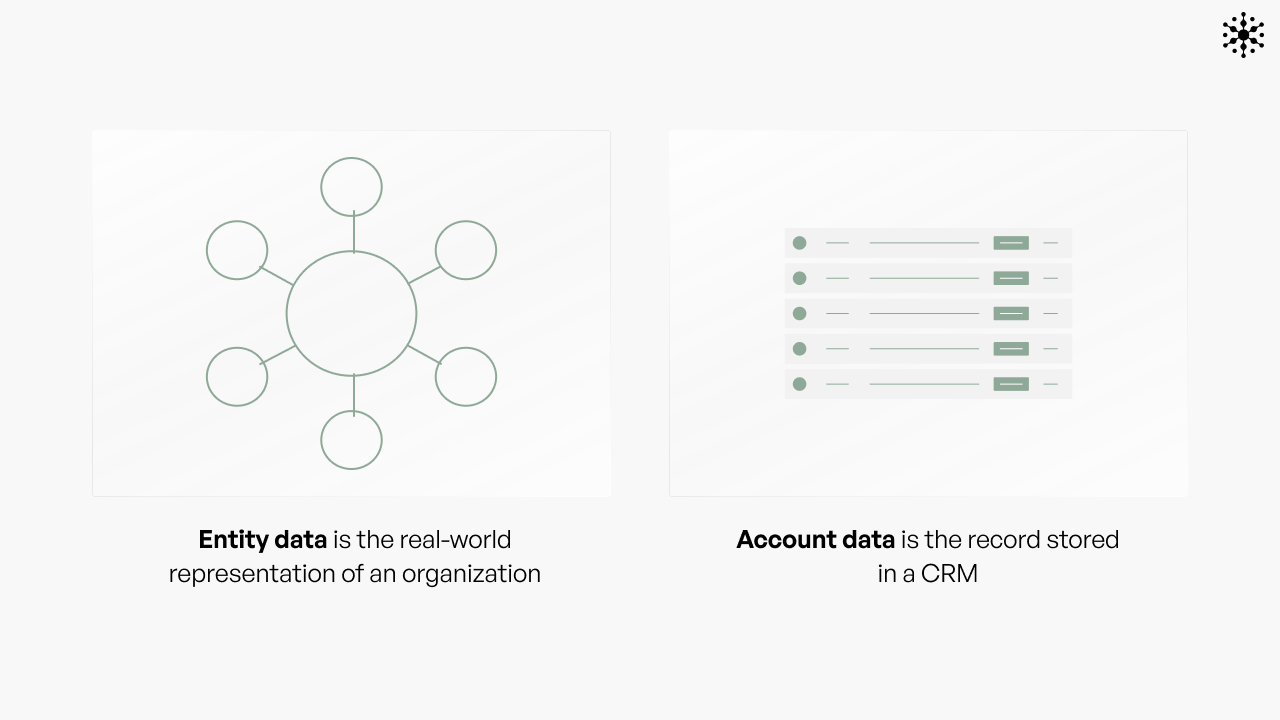
What is the difference between entity data and account data?
- Entity data is the real-world representation of an organization. It combines all underlying records into a single verified identity, creating a reliable foundation for every downstream process
- Account data is the record stored in a CRM. It’s useful for tracking interactions, opportunities, and activity, but it can contain duplicates, incomplete fields, or inconsistent identifiers
Entity data becomes account data when it is integrated into the CRM and used to define accounts. Accurate go-to-market decisions depend on a one-to-one mapping from real entities to accounts.
What is the impact of entity identity issues?
Most organizations know their CRM data has problems, but few address the root cause.
- 90% of organizations see CRM data as central to their operations
- 76% say less than half of their CRM data is accurate and complete
- 37% lose revenue directly due to poor data
- 1 in 4 companies experience a 20% or greater drop in annual revenue
- 16 deals are lost per quarter on average due to bad data
- 37% report delayed key revenue-generating initiatives
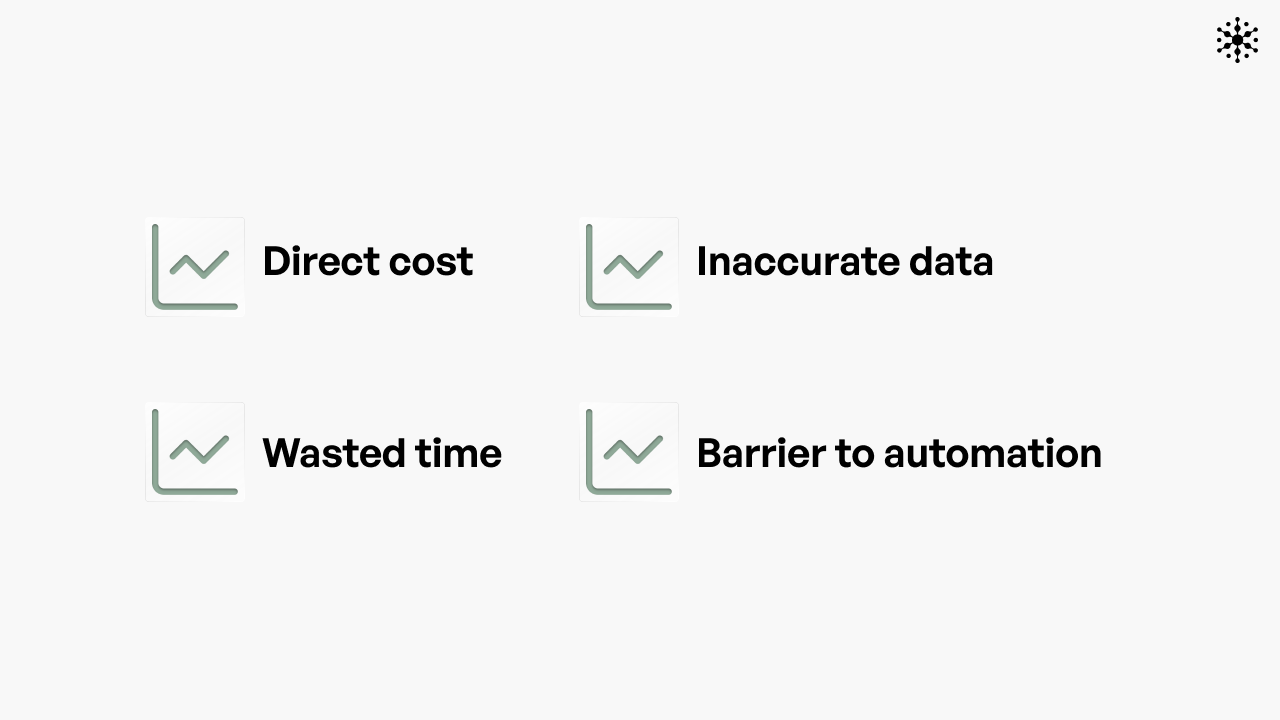
Poor entity identity has a compounding impact across businesses, affecting revenue, planning, and automation.
Direct cost
RevOps teams spend heavily on data providers that sell stale, generic data. They also rely on manual corrections, enrichment workflows, and external consultants to patch data problems.
Wasted time
RevOps and data teams spend hours fixing records, while reps continue to flag obvious errors. Reps end up spending time fixing data instead of selling.
Inaccurate territories
Accounts are often assigned to the wrong reps, reducing revenue potential. Headcount planning and segmentation rely on guesswork, and missing accounts lead to lost opportunities unless reps self-source them.
Barrier to automation
AI and automation only work when your entity data is accurate. If the records are wrong or incomplete, the results can’t be trusted, reducing the value of these tools and workflows.
How does Kernel resolve entity identity?
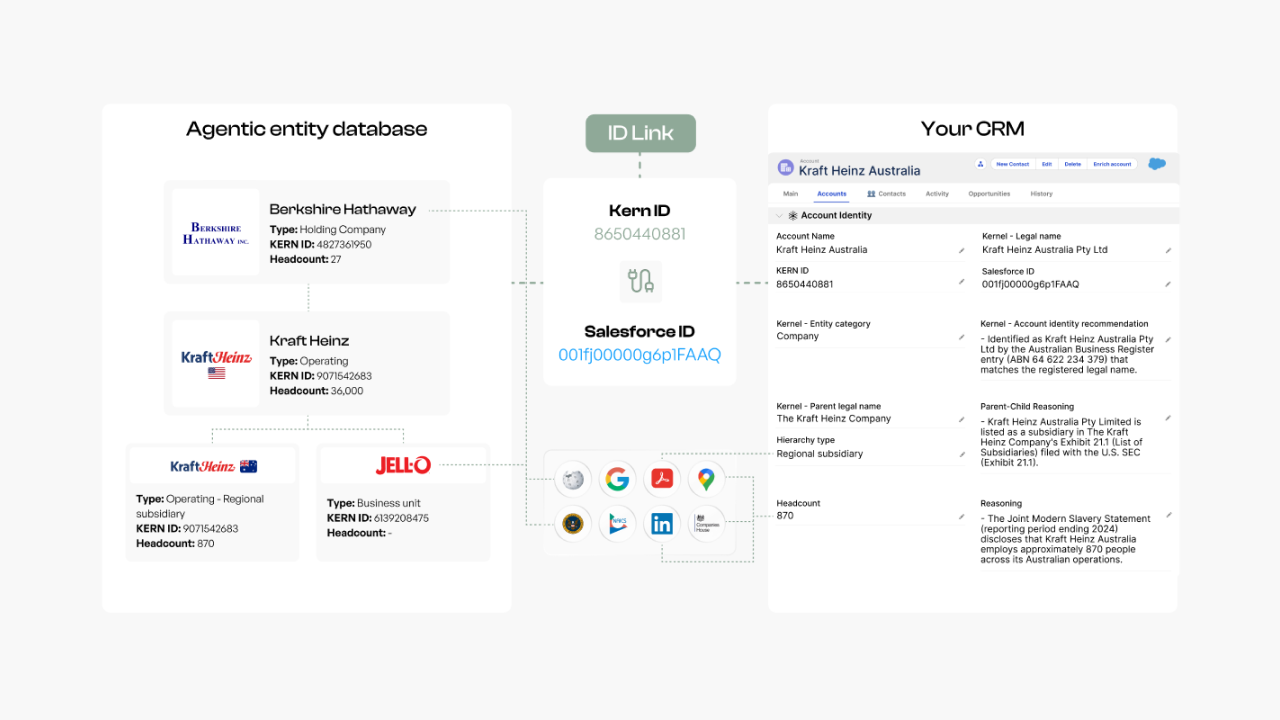
Kernel solves the root cause of CRM data inaccuracy by combining an entity database with agentic reasoning.
First, every account in your CRM is matched to our entity database. Each account is linked to a unique KERN ID, creating a connection between your CRM records and verified organizations. This establishes a clean, reliable data foundation.
On top of this, agents extract and interpret context from CRM notes and unstructured data on the public web like company websites, regulatory filings, Wikipedia pages, and PDFs.
This turns the CRM from a static, inaccurate database into a continuously maintained system that combines entity data, AI agents, and contextual information.
How it works:
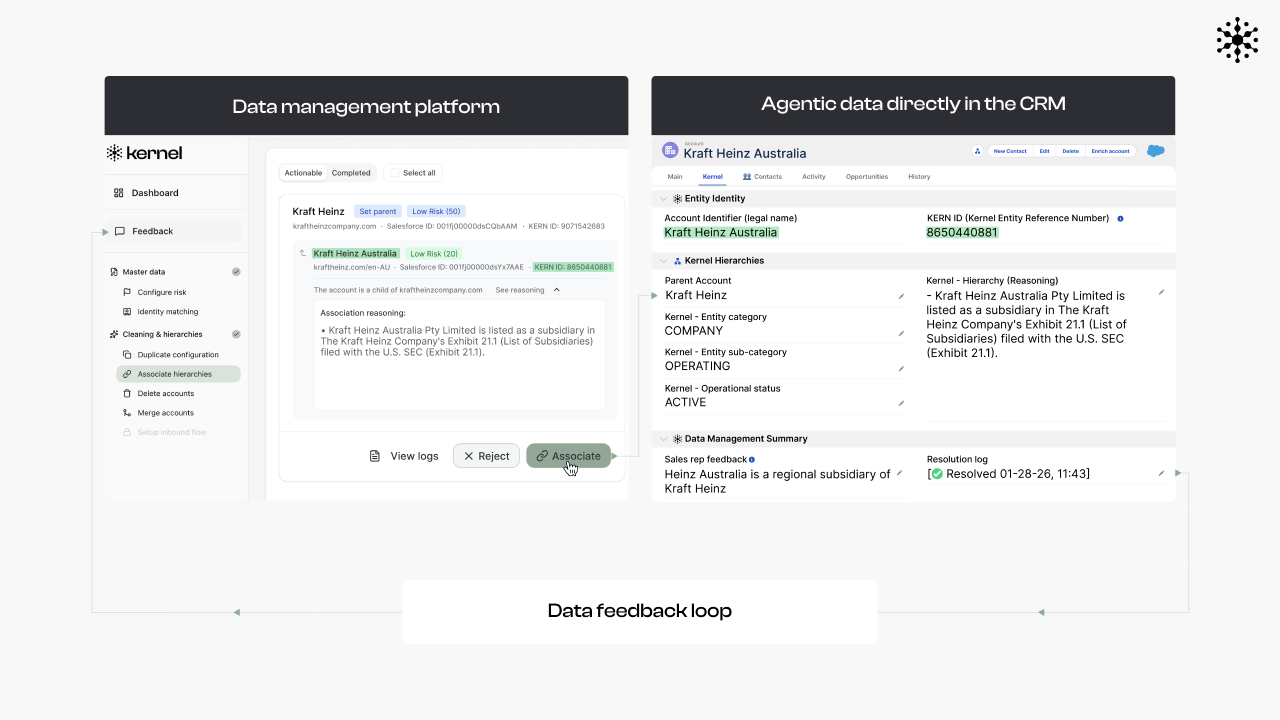
- Data management platform: RevOps teams can manage entity data directly within the CRM. Tasks such as merging duplicates, resolving hierarchies, or deleting accounts can be performed safely at scale.
- Deep CRM integration: Kernel integrates directly with your CRM to keep data accurate and up to date while giving teams control over syncs.
Continuous feedback loop
Data quality improves over time through a built-in feedback system. Teams can flag issues, which are investigated and corrected within 48 hours.
With Kernel, CRM accounts map to verified entities and accurate hierarchies. The result is structured, trustworthy data that supports every revenue process.
Why does entity identity come first?
When working with CRM data, the order matters.
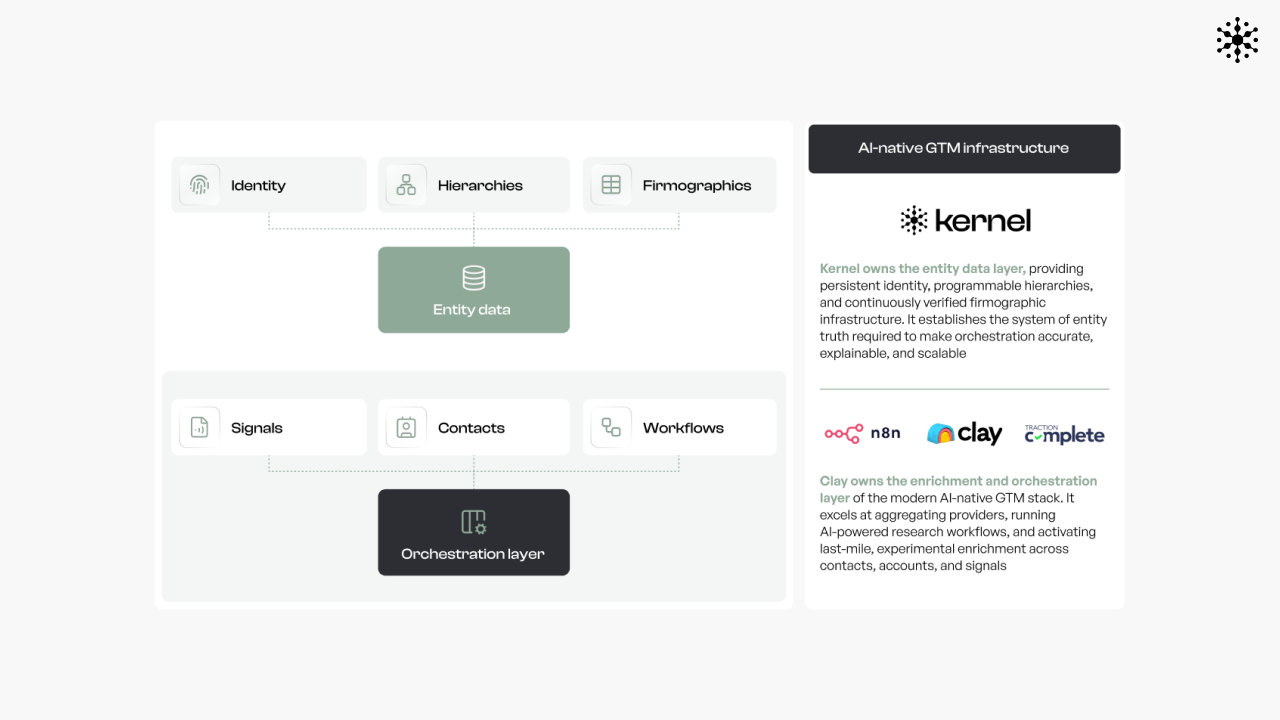
- Entity identity: The verified, real-world representation of a company, including parent-subsidiary relationships and corporate hierarchies. This is the foundation of your CRM data
- Enrichment: Adds context such as firmographics, technographics, and industry classification
- Orchestration: Automates workflows, scoring, campaigns, and AI-driven processes based on the CRM data
A lot of companies start by buying enrichment tools, hoping that more data will improve targeting or segmentation.
But if you cannot answer the question “Which company is this?” for a CRM account, the problem is entity identity, not enrichment.
Without a reliable identity layer, enrichment and automation cannot deliver reliable results.
Once entity identities are verified, tools like Unify, Clay, n8n, and Traction Complete can work effectively. Accurate entities ensure downstream processes operate reliably, maximizing ROI and reducing wasted spend.
What happens when your CRM has an accurate data foundation?
Investing in entity identity resolution leads to measurable improvements across revenue operations.
True market visibility
With duplicates removed and hidden entities surfaced, total addressable market and whitespace analysis reflect real opportunities. Strategic decisions are based on actual data, not distorted counts or incomplete views.
Improved rep productivity
Sales and RevOps teams spend less time on manual cleanup and more time on revenue-generating activities, boosting revenue per rep and improving engagement outcomes.
Better territory planning
Territories built on verified hierarchies reduce overlap, ensure coverage of all buying centers, and align teams to the right organizational units.
Coordinated enterprise selling
Clear parent-subsidiary visibility allows sales, success, and support teams to collaborate across complex accounts, unlocking upsell and cross-sell opportunities.
Streamlined data stack
A centralized entity identity layer reduces reliance on multiple enrichment vendors, deduplication tools, and manual processes, lowering costs and easing governance.
Speak to us today
Talk to Kernel to resolve entity identities and build a CRM your team can rely on.



.png)
